🇰🇷 'Pohang-Style' Mulhoe Costs More in Seoul Than It Does in Pohang. I Went to Find Out Why. (2026)
A friend in Seoul once sent me a screenshot from a delivery app, confused about why a restaurant was charging extra for something called "포항물회" — Pohang-style raw fish. They'd never been to Pohang in their life. I had, more than once, for a dish that in its actual hometown isn't a novelty item on a menu. It's just what you order on a Tuesday.
That mix-up is basically the whole story of this city. Close to 2 million people show up every year to photograph one sunrise at a bronze sculpture on the coast, and almost none of them ask what the fishing boats bring in a few kilometers down the road. So here's the food side of Pohang — the one that got exported to Seoul under the city's name, and the two that never left.
🌅 The Reason Everyone Actually Shows Up
If you've heard of Pohang at all, it's probably for Homigot (호미곶) — the easternmost point on the mainland, marked by the "Hand of Coexistence" (상생의 손), two giant bronze hands reaching out of the sea and the land. Cartographer Kim Jeong-ho reportedly surveyed the spot seven times while mapping Korea in the 1800s, and it's been treated as a symbolic starting point ever since. The annual New Year's sunrise festival here pulls in roughly 2 million visitors a year, most of them Korean, almost none of them foreign.
💡 Pro tip: Nobody local actually eats dinner at Homigot. It's a sunrise stop, not a food destination. The real eating happens back toward Guryongpo port and the Jukdo Market downtown — which is exactly what the sunrise crowd tends to skip.
🐟 What "Pohang-Style" Mulhoe Actually Means
Mulhoe (물회) — raw fish mixed cold with vegetables and a sweet-and-sour gochujang base — exists all along Korea's east coast, and different ports have different versions. Sokcho, further north, runs a brothier, soupier style and has chains built around claiming to be the "original." Pohang's version leans the other way: less liquid, more raw fish and crunchy vegetables that you mix yourself until it's closer to a spicy raw-fish salad than a soup.
The name traveled before most foreign visitors ever did. Restaurants in Seoul and Gyeonggi now sell a menu item literally called "포항물회" (Pohang mulhoe) specifically because the style built a reputation — and they charge accordingly, often 💰 ₩17,000–22,000 (~$12.70–16.50) for a bowl, hundreds of kilometers from the water it's named after.
⚠ Note: In Pohang itself, you're not paying a premium for the name — you're paying for whatever came off a boat at Jukdo Market that morning, which is a different kind of value than the branding suggests.
🍲 모리국수 (Mori-guksu) — The Soup Named "Everyone Gathers"
This is the dish I'd actually send someone to Guryongpo for. Mori-guksu started as a way for fishing families to stretch the odds and ends of the catch — bits of anglerfish, small crab, shellfish, whatever didn't sell — into a noodle soup that could feed everyone at once. The name itself comes from "모여서 배불리 먹는다" — roughly, "everyone gathers and eats until full."
It's rough-edged on purpose: a spicy, anchovy-based broth loaded with fresh noodles, crab legs, and whatever seafood came in that day, built to be shared rather than plated individually. Most of the small shops around the harbor won't even sell you a single bowl — it's a two-serving minimum dish at most places, which tells you how it was designed to be eaten. One shop, 말봉국수, breaks that rule and sells solo portions for 💰 ₩10,000 (~$7.50); everywhere else runs closer to 💰 ₩7,000 (~$5.25) per serving with that two-person minimum.
🎁 Fun fact: You will not find this on a "Top Korean Dishes" list anywhere. It barely exists outside this one stretch of coastline.
❄️ 과메기 (Gwamegi) — Only Here, and Only in Winter
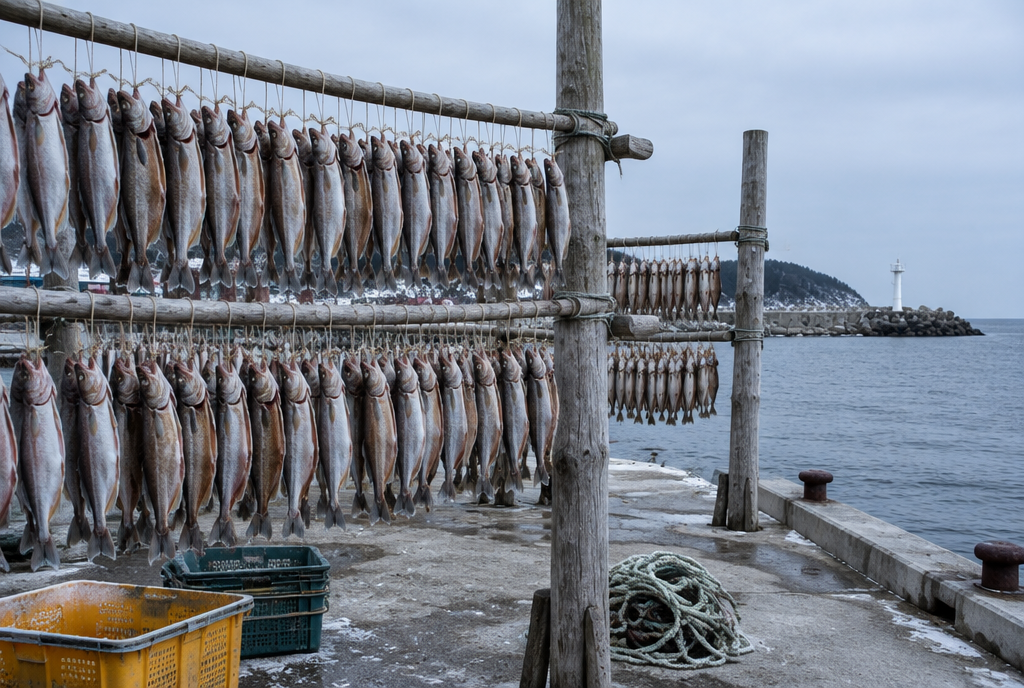
If mori-guksu is the everyday dish, gwamegi is the seasonal event. It's half-dried Pacific saury, hung outdoors along the Guryongpo coast through the cold months so the fish freezes overnight and thaws by day — a slow natural cure that locals say the wind itself is responsible for. There are two styles: the traditional whole-fish version (통마리), left ungutted and dried in shade for about two weeks for a deeper flavor, and a faster split version (배지기) that's gutted and boned, ready in three or four days.
The Pohang Guryongpo Gwamegi Festival, usually held in mid-November at Guryongpo's harbor plaza, draws around 20,000 visitors over its two days for discounted sales, gwamegi kimbap tasting, and an arm-wrestling contest that has nothing to do with fish and everything to do with small-town festival energy. Outside festival season, it's sold by weight straight out of Jukdo Market stalls, usually wrapped with garlic, chili, and perilla leaf and eaten by hand — nothing like the vacuum-sealed, shipped-overseas versions you'll find marketed internationally as a specialty gift box.
⚠ Note: The season is short — roughly November through February. Show up in summer asking for gwamegi and you'll get a polite explanation about wind and weather, not a plate.
🏪 Jukdo Market Is the Actual Attraction
If you only have time for one stop, make it Jukdo Market (죽도시장), Pohang's main market and the place all three of these dishes actually converge — fresh catch coming in, mori-guksu stalls, mulhoe counters, and gwamegi sold by weight depending on season. It's not styled for tourists the way some bigger city markets have become, which is exactly the point. Nobody here is performing "authentic Korea" for a camera; they're just running a fish market the way they have for decades.
Pohang was never going to compete with Busan or Gangneung for name recognition, and it's not trying to. It's a working port city that happens to have a famous sunrise at one end of it. Go for the hands reaching out of the sea if you want. Just don't leave without finding out what's actually for dinner.
Internal links for more of this series: 8 Korean Foods Locals Order Without Blinking, I Skipped Jagalchi Market and Ate Where Busan Actually Eats Lunch, and Everyone Photographs Gyeongju's Tombs. Nobody Asks What's for Lunch Next to Them.
Illustration generated with AI.


Comments
Post a Comment