🇰🇷 Visiting Korea During Chuseok 2026? Here's What Actually Closes (And What Doesn't)
If you're eyeing flights to Korea for late September 2026, here's something most booking sites won't tell you: you might be flying straight into Chuseok (추석), Korea's biggest holiday of the year. This year it lands on September 24–26, and it changes almost everything about how the country runs for those three days — plus a few days on either side. I've seen tourists show up expecting a ghost town, and others who had no idea it was happening at all and got completely blindsided by a sold-out train. Neither reaction is right. Here's what actually happens.
📅 What Chuseok(추석) actually is (and why it's not like a Western holiday)
Chuseok is Korea's harvest festival and family holiday — think Thanksgiving, but with the entire country traveling on the same three days. Families gather at the eldest son's hometown, share a big meal, and visit ancestral graves. It's less "everything closes for a religious observance" and more "an entire nation of 51 million people tries to drive to their hometown at once."
💡 Pro tip: The holiday isn't just the 24th–26th. Expect lighter crowds and some closures creeping in the day before and after too, since a lot of people take the Wednesday or the following Sunday off to make a longer break.
🔒 What actually shuts down
This is the part that catches people off guard. During the official three days:
- Banks, government offices, and post offices are closed the entire time.
- Most neighborhood restaurants and small shops close — a lot of owners are the ones driving home for the holiday.
- Small clinics and dental offices are largely shut (hospitals and ERs still operate 24/7 by law, so don't panic).
- Traditional markets close on the holiday days themselves.
- Big department stores close for roughly two of the three days, though this varies store to store.
⚠ Note: This is exactly why a trip planned entirely around trendy restaurant reservations can fall apart during Chuseok — always have a backup plan for meals during these dates.
🏪 What stays wide open
Here's the good news: Korea doesn't actually stop. A few things you can always count on:
- Convenience stores (CU, GS25, 7-Eleven, emart24) run 24/7, holiday or not — genuinely a lifesaver if you're hungry at 11pm on Chuseok night.
- Movie theaters (CGV, Lotte Cinema, Megabox) stay open, and honestly get busier, since watching a movie is a classic Chuseok activity for locals too.
- Western fast food chains, hotel restaurants, and most coffee shops keep their doors open, sometimes with slightly earlier closing hours.
- National parks and hiking trails run as normal — if you want to escape the holiday crowds entirely, a mountain trail is a solid move.
🎁 The free palace loophole nobody talks about
Here's a genuinely great reason to be in Seoul during Chuseok: Gyeongbokgung, Changdeokgung, Deoksugung, Changgyeonggung, and Jongmyo Shrine all offer free admission on the official Chuseok days. Several palaces also run special traditional performances during the holiday. If you were going to pay for palace entry anyway, timing your visit for one of these three days is basically a free upgrade.
🚄 The KTX trap that catches almost every foreign traveler
This is the one that actually matters if you're planning to move between cities during the holiday. Chuseok train tickets don't go on sale through Korail's normal 30-day rolling booking window — there's a separate holiday sale with its own announcement date, usually posted on Korail's notice board weeks ahead of time, and tickets are distributed more like a lottery than a first-come-first-served rush.
A standard Seoul–Busan KTX ticket normally runs about 💰 ₩59,800 (~$44.50) one way, but during the Chuseok window, the real challenge isn't the price — it's that seats can be gone before most tourists even know the sale happened. If you're planning any inter-city travel around the 24th–26th, lock in tickets the moment Korail opens the holiday sale, and keep SRT (a separate high-speed operator out of Suseo Station) and express buses in mind as backups.
💡 Pro tip: Set up your Korail Membership account with your passport number well before the holiday sale opens — you can't apply for holiday tickets without one, and creating an account on the spot under time pressure is not fun.
🚗 The great 귀성길 traffic jam
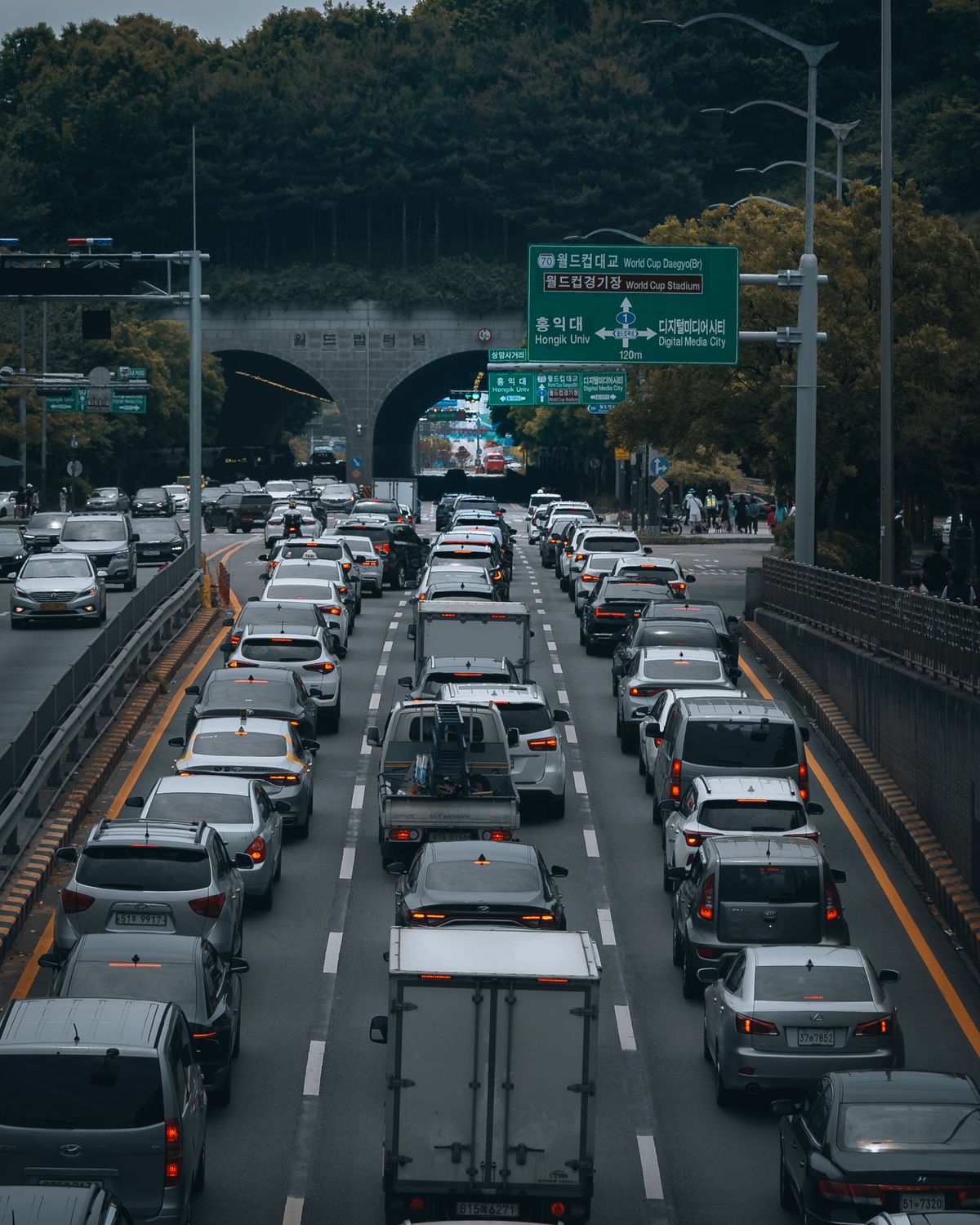
Real gridlock on a Seoul expressway near World Cup Stadium — this is basically every road out of the city during Chuseok. Photo by Jakob Jin, Pexels.
Koreans have a specific word for the holiday journey home: 귀성길 (gwiseong-gil), literally "the road home." Highways nationwide turn into what looks like a permanent traffic jam in the days right before and after Chuseok, as millions of people drive to their hometowns. If you're renting a car for a road trip, avoid the day before and the last day of the holiday specifically — those are the worst.
The Seoul subway keeps running throughout 명절 (myeongjeol, the general word for major traditional holidays like Chuseok and Lunar New Year), just on a reduced holiday schedule with longer gaps between trains. If you already know how your T-money card works and you're navigating with Naver Map or Kakao Map instead of Google Maps, getting around the city itself is honestly no harder than any other day — it's the intercity travel that needs planning.
🍽️ How to actually eat well during the holiday
Don't panic about food. Between 24-hour convenience stores, department store food courts on their open day, hotel restaurants, and the fact that most tourist-area restaurants in neighborhoods like Myeongdong or Hongdae tend to stay open specifically because they cater to visitors, you won't go hungry. It's the quiet residential-neighborhood spots that shut their doors — the touristy strips mostly carry on as usual.
Honestly, a Chuseok trip isn't a trip to avoid — it's just a trip that rewards a little homework. Book your intercity tickets early, grab a free palace visit while you're at it, and let the convenience stores carry you through the rest. See you in Seoul.
Enjoy~

Comments
Post a Comment