🇰🇷 A Stranger Scrubbed My Dead Skin Off in a Korean Bathhouse. Here's Why I Keep Going Back (2026)
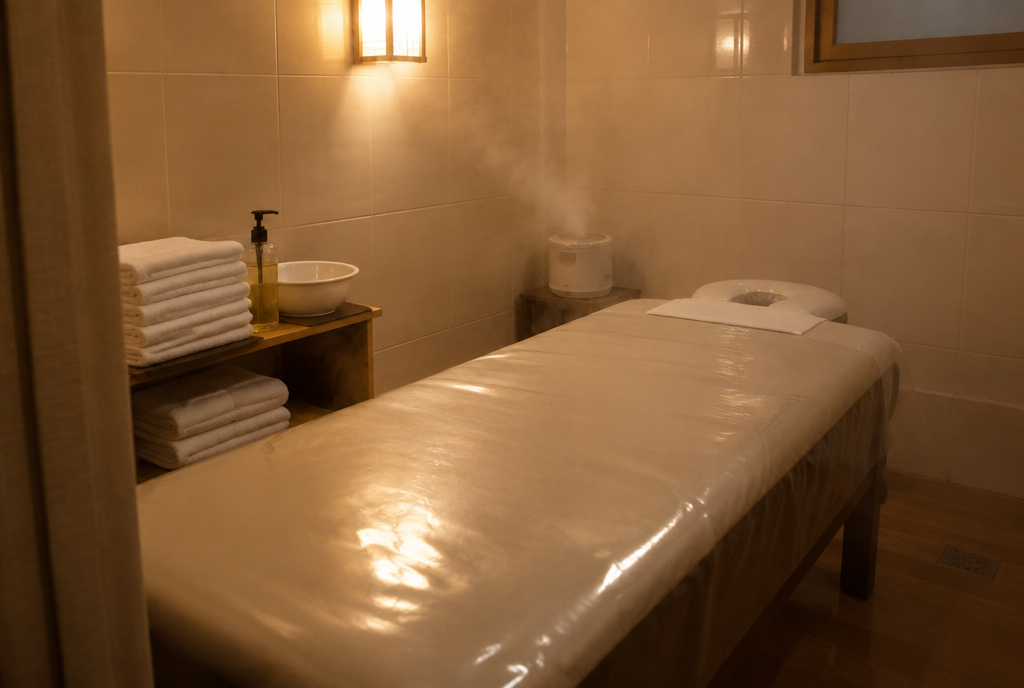
My college roommate visited last spring and, on day two, I dragged her to my neighborhood bathhouse without explaining much beyond "trust me." Twenty minutes later she was lying face-down on a vinyl table in her underwear while a woman in a black bra and shorts scrubbed her back so hard that gray rolls of dead skin were falling onto the mat below. She texted me that night: "I don't know if I was traumatized or if that was the best thing that's ever happened to my skin." Both, honestly. That's seshin (세신), and almost nobody explains what it actually involves before you're lying on that table.
🧖 What "Seshin" Actually Is
Seshin just means "washing the body," but in practice it's a full-body exfoliation done by a professional — not something you do to yourself. You lie on a plastic-covered table inside a bathhouse or private scrub salon, and a seshinsa (목욕관리사, literally "bathing manager") works over your entire body with a coarse mitt, removing weeks of dead skin in about 20–30 minutes. It's less "spa treatment" and more "a very direct, very effective chore someone else does for you." If you've ever had a European-style black soap and kessa glove hammam scrub, it's the same category of experience, just Korean in execution and a fraction of the price.
🙈 The Nudity Part Everyone Panics About
Yes, it's done in the nude, in a gender-separated area. This is the part that stops most first-timers from ever trying it, and it's also the part that turns out to be a non-issue within about five minutes. Korean bathhouses run on an assumption that nobody in that room is thinking about your body at all — everyone's there for the same reason, half-asleep in hot water, and genuinely not looking. The anonymity is oddly relaxing once the initial adjustment wears off.
⚠ Note: If full communal nudity is a hard no for you, private boutique scrub salons (as opposed to public bathhouses) offer individual rooms with just you and the seshinsa — same scrub, zero communal bathing required.
🎨 The Color-Coded Towel I Didn't Know Existed
The scrub mitt itself has a name too — Koreans and foreign residents alike call it the "Italy towel," a viscose rayon glove invented in Busan in the 1960s that has nothing to do with Italy (the fabric was originally imported and the name stuck). What I didn't know until years in: the mitts are color-coded by abrasiveness. Yellow is gentlest, then pink, green, blue, and red is genuinely intense. Most bathhouses default to green or blue unless you ask, so if you have sensitive skin, say so before they start.
🎁 Fun fact: The mitt is sold in nearly every Korean supermarket and Olive Young for home use, but it's a completely different experience solo — you physically cannot reach or apply the same pressure to your own back, which is most of the point.
💰 What It Actually Costs
Prices vary a lot depending on whether you go to a no-frills neighborhood bathhouse or a private boutique salon, and the two aren't really comparable experiences:
- Traditional bathhouse entry fee: 💰 ₩10,000–15,000 (~$7.20–$10.80), which just gets you into the baths
- Scrub add-on at the same bathhouse: 💰 ₩20,000–25,000 (~$14.40–$18.00), paid separately to the seshinsa, usually in cash
- Private boutique salon, 60-minute session, all-inclusive: 💰 ₩80,000–150,000 (~$57.65–$108.15)
- Full course with oil massage and a face/body mask: 💰 ₩150,000–250,000 (~$108.15–$180.25) at the higher end
💡 Pro tip: The traditional bathhouse route is dramatically cheaper and, honestly, closer to how most Koreans actually experience this — it's a neighborhood errand, not a luxury outing. Save the private boutique version for when you want privacy, English-speaking staff, or a guaranteed reservation instead of walking in and hoping the seshinsa isn't fully booked.
🕐 How It Actually Goes
At a traditional bathhouse, you soak in the hot pool for 15–20 minutes first — this matters, since the scrub barely works on dry, unsoftened skin. Then you're called over to a vinyl table where the seshinsa moves you through facedown, side, and faceup positions, working systematically from neck to feet. It's not gentle, and it's not meant to be relaxing in the way a Western spa massage is — it's closer to a very thorough exfoliation appointment that happens to also feel oddly cathartic. A cool rinse at the end closes your pores, and some places finish with a quick cucumber or milk treatment on your face.
Related: if you want the scrub paired with a longer wellness day, I've written separately about Korean scalp treatments (head spa) and facial sessions, which are usually booked as a separate appointment on a different day rather than stacked with seshin.
🗣️ The One Phrase You Need
At a public bathhouse, nobody hands you a menu. You have to ask. The phrase is: "세신 해주세요" (seshin hae-ju-se-yo) — "please do the scrub for me." Say it at the counter when you pay your entry fee, or directly to a seshinsa if you see one sitting near the baths waiting for customers. That's really the whole booking process at a neighborhood bathhouse — no app, no reservation, just showing up and asking.
⚠ What Not to Do Right After
Your skin is genuinely raw afterward, not just "smooth" — this isn't a light exfoliation. Skip retinol, exfoliating acids, or anything with active ingredients for about 48 hours. Avoid direct sun without strong SPF, and don't plan an intense workout right after since your skin barrier needs a beat to recover. What you should do: apply a plain toner or essence within a few minutes while your skin is still slightly damp, since it absorbs noticeably better right after a scrub. If you're curious what locals actually layer on afterward, I broke that down in this piece on the real Korean skincare routine.
This isn't going to show up on a "Top 10 Seoul Attractions" list, and that's exactly why it's worth doing. It's cheap, it's unglamorous, and it's one of the few things on this blog you genuinely cannot get the same way anywhere else.
Illustration generated with AI.


Comments
Post a Comment