🇰🇷 My Convenience Store App Just Tried to Sell Me a $22,000 Robot (2026)
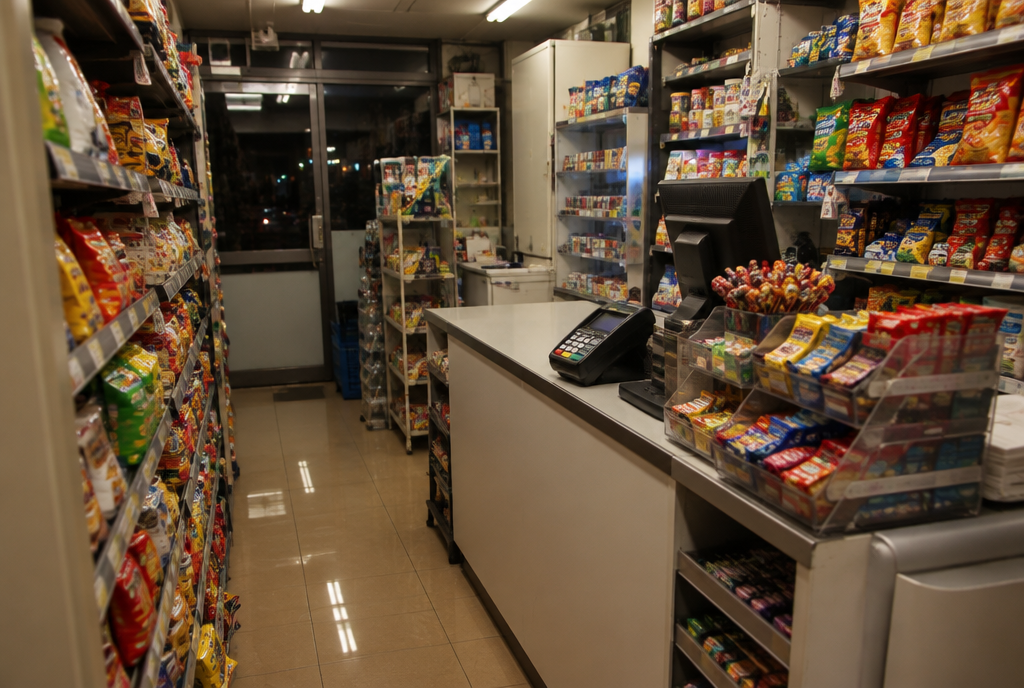
I opened my neighborhood CU's app last night to reorder the same triangle kimbap I always get, and got stopped by a banner for a robot. Not a toy robot — a full-size, two-legged humanoid robot, listed at ₩31,000,000. Scroll down two more rows and there's a Prada crossbody bag at 40% off. This is not a joke account or a scam pop-up. This is Pocket CU, the loyalty app for one of Korea's biggest convenience store chains, and apparently it now moonlights as a discount department store.
📱 Pocket CU Isn't What You Think a Convenience Store App Is
Most convenience store apps anywhere in the world do one job: stamp your loyalty points, maybe flash a coupon. Pocket CU does that too, which is why I had it installed in the first place. But somewhere along the way it turned into a second, much stranger storefront — one where CU sells things you will never see on a physical shelf inside the actual store, ordered through the app and either delivered or picked up.
The chain's own reasoning, reported in local coverage, is blunt: some products are simply "difficult to display in-store," so they get rotated through the app instead, on a recurring schedule rather than as one-off stunts. It's working — Pocket CU's monthly active users have climbed to somewhere between 2.5 and 2.7 million, which is a lot of people checking a snack app and walking away having browsed handbags.
🤖 The Robot That Started All of This
The flagship item in CU's current gift catalog — over 710 products deep, most of it aimed at Chuseok gift-giving — is a two-legged walking humanoid robot priced at 💰 ₩31,000,000 (~$22,318). It is, by a wide margin, the most expensive thing a Korean convenience store has ever tried to sell me through an app.
It's not alone. The same lineup includes a smart robotic companion dog at 💰 ₩3,990,000 (~$2,873) and an AI-powered baduk (Korean Go) playing robot, for six robot products in total. CU has said outright that the point is to ride the AI and robotics wave that's dominating Korean headlines this year — and, just as important, to give people something to talk about.
🎁 Fun fact: that "something to talk about" strategy has numbers behind it. CU's last Lunar New Year sales rose 13.8% year over year, and sales of items priced above ₩100,000 specifically jumped 39.2%. A ₩31,000,000 robot isn't really there to sell in volume — it's there to make you open the app, and then buy the ₩15,000 gift set two scrolls down instead.
👜 The Handbags Are the Part That Actually Surprised Me
Running right now, from September 21 through October 4, is what CU is calling its weekly designer pop-up — a rotating sale of 19 bag and jewelry styles from Prada, Gucci, Celine, and Ferragamo, discounted up to 45% off standard retail. It rotates on a set schedule rather than showing up once around a holiday and disappearing, which is the detail that makes this feel less like a gimmick and more like CU testing a permanent new business line.
💡 Pro tip: this isn't something you'll stumble onto by walking into a physical CU — it lives entirely inside the app, under a section most people never tap into because they opened Pocket CU for the 1+1 coupon and nothing else. If you're curious what a Korean convenience store's idea of a flash sale looks like, it's worth a scroll even if you have zero intention of buying a bag from a snack app.
🌍 Imagine If Your Local 7-Eleven Did This
The closest comparison I can offer a Western reader: picture your neighborhood 7-Eleven's rewards app suddenly listing a Peloton bike and a Louis Vuitton tote next to your usual Slurpee coupon, on a rotating weekly schedule, and actually shipping them to your door. That's the scale of the gap between what a "convenience store app" is expected to do here versus what CU has quietly built Pocket CU into.
This is the kind of thing you only notice by having the app installed for something mundane and getting ambushed by it later — nobody puts "convenience store sells robots" on a tourism brochure, because it isn't a place to visit. It's just what's sitting on a lot of Korean phones right now, mine included.
🛍️ Could a Visitor Actually Buy One?
⚠ Note: realistically, probably not easily. Pocket CU's checkout runs through Korean payment rails and generally expects a Korean phone number to register, so this isn't a "download it for your trip" recommendation the way the smoothie machines at the corner store are. Think of this less as a shopping tip and more as a small window into how aggressively Korean retail chains are experimenting with what a "convenience store" is even allowed to sell — which, if you're the type who reads about what's actually worth buying here versus skipping, is a pretty good sign of where the interesting stuff in Korean retail is headed next.
I still haven't decided if I'm more entertained or unsettled by a walking robot sharing app real estate with my kimbap order. Either way, I'm checking that banner every week now just to see what shows up next.
Illustration generated with AI.


Comments
Post a Comment