🇰🇷 I Left My Trash Out in the Wrong Bag. It Sat There for Four Days. (2026)
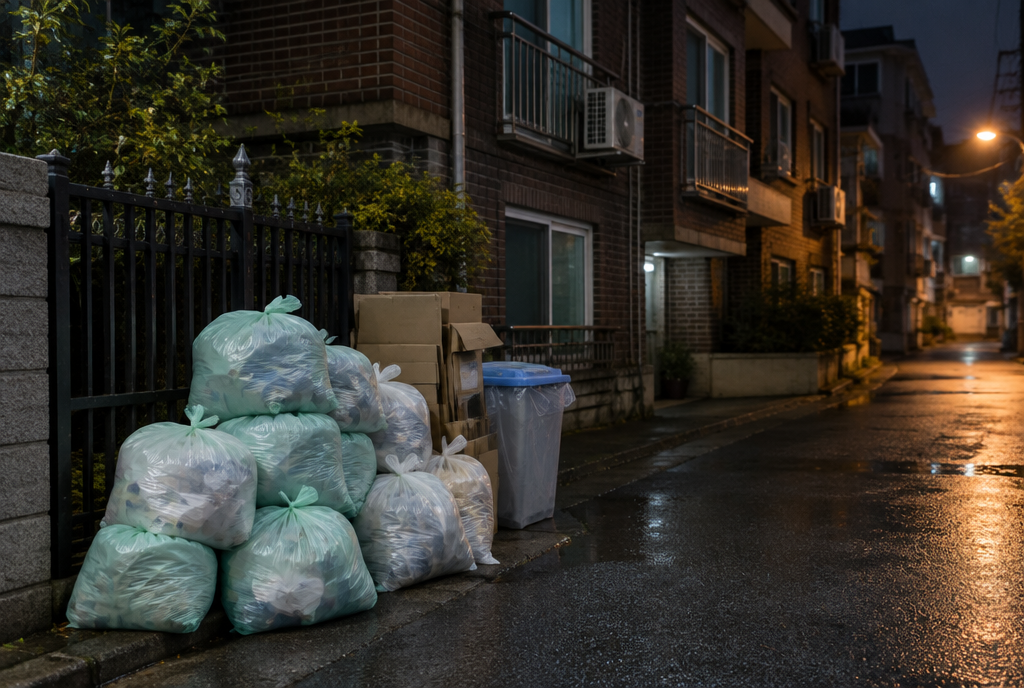
A friend crashing at my place for a few nights grabbed the kitchen trash, tied up a regular black bag from the corner store, and set it outside the gate like it was the most normal thing in the world. Four days later it was still sitting there, untouched, slowly leaking. Nobody in Korea was ever going to pick that bag up, and nothing about it explained why.
🛍️ The Bag Is the Whole System
Korea doesn't collect trash by the can — it collects it by the bag, and only one kind of bag counts. It's called a 종량제 봉투 (jongnyangje bongtu, literally "volume-rate bag"), and it's the only container the truck is allowed to take. Anything else — a random black bag, a shopping bag, a box with no sticker on it — just gets left on the curb, sometimes with a warning tag stuck to it, until someone reports it or it quietly becomes a neighbor's problem.
💡 Pro tip: These bags are sold at any CU, GS25, 7-Eleven, or local mart, usually stacked right by the register. Ask for "종량제 봉투" and hold up fingers for the liter size if your Korean stalls out.
💰 Same Bag, Wildly Different Price Depending on Your Address
Here's the part that trips up even long-term residents: the price isn't set nationally. Every city and district sets its own rate based on what disposal actually costs them, so an identical 20-liter bag can run:
- 💰 ₩490 (~$0.36) in parts of Seoul
- 💰 ₩622 (~$0.46) in Daegu
- 💰 ₩758 (~$0.56) in Incheon
- 💰 ₩840 (~$0.62) or more in some Gyeonggi-do districts
Think of it less like a trash bag and more like a prepaid parking meter for garbage — you're paying for disposal capacity, not the plastic. And a bag bought in one district is basically useless in another: the district name is printed on it, and collectors elsewhere won't take it.
🍚 Food Waste Lives in a Completely Different Universe
General trash and food waste never go in the same bag — mixing them breaks two rules at once. Depending on the building, food waste goes out one of two ways: a separate food-waste bag, or, increasingly in newer apartment complexes, an RFID bin that weighs what you dump and bills the household by the gram. One district's rollout of these bins cut household food waste by roughly 23.5% since 2018, just by making people watch the number climb in real time.
⚠ Note: "Food waste" here is narrower than it sounds. Rice, vegetable scraps, and leftover banchan count. Bones, eggshells, shellfish shells, fruit pits, onion and garlic skins, tea bags, and coffee grounds do not — those go in general waste, even though they're technically food.
📅 Trash Day Is Not Every Day
You can't just set a bag out whenever the mood strikes. Most buildings and districts run on fixed collection days and windows — often evening-only, so the street isn't lined with bags all day — and putting bags out too early is its own small violation. Recycling (paper, plastic, glass, cans, styrofoam — rinsed and sorted by material) usually runs on a separate schedule, once or twice a week, and tossing it into the general bag defeats the entire point of paying for that bag by volume.
🚫 What Actually Gets You a Fine
This isn't just an etiquette thing — there's real money behind it. Illegal dumping — a non-official bag, or no bag at all — can draw a fine starting around ₩100,000–200,000 (~$74–148) for a first offense, climbing to ₩300,000–500,000 (~$221–369) for repeat violations, and up to ₩1,000,000 (~$738) for large or combined violations. Furniture and mattresses need their own disposal sticker (₩3,000–15,000, ~$2.20–$11) — leaving a bed frame at the curb with no sticker gets treated the same as dumping it illegally.
💡 What Actually Works If You're Just Passing Through
If you're staying somewhere short-term, nobody expects you to know any of this on arrival — but they do expect you to ask. A thoughtful host usually has the right bags stocked under the sink or in a cabinet; if you don't see any, ask "종량제 봉투 어디 있어요?" (where are the pay-per-use bags?) before improvising with whatever plastic bag is lying around. It sounds like overkill for a system this specific, but once someone points you to the right stack, the rest genuinely takes care of itself. For a few more of these small logistics nobody explains upfront, the first-time visitor mistakes post and the T-money card mistakes post cover a few more.
The bag went out again a few nights later — right one this time — and it vanished like it had never been there. That's honestly the whole trick.
Illustration generated with AI.


Comments
Post a Comment