🇰🇷 Everyone Orders Black Pork in Jeju. Locals Are Eating Something Else Entirely. (2026)
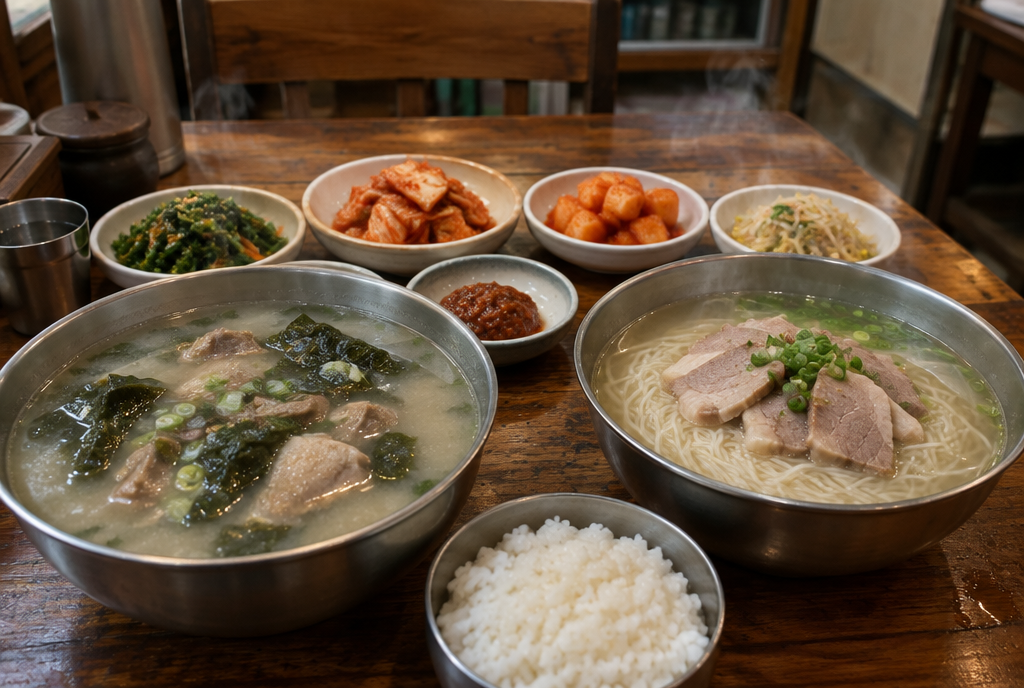
A friend texted me their Jeju itinerary before landing last month, and three of the five dinners were already black pork BBQ. I didn't say anything at the time, but I've lived here long enough to know that's not really what's on the table when Jeju people feed each other. Black pork isn't a myth — it's just the version of Jeju food built for a menu with photos and an English translation. The version locals actually reach for looks a lot less Instagrammable, and most of it has never needed a name in English at all.
🥣 The Soup That Used to Divide an Entire Pig Between a Village
Momguk (몸국) is a cloudy, pork-bone broth thickened with mojaban, a local seaweed that only really shows up in Jeju cooking. It's not a light dish — pork meat, organs, and sometimes a bit of blood sausage go into the pot along with the broth — but the seaweed cuts the greasiness in a way that makes it disappear fast.
What sold me on it wasn't the taste, though. It's why it exists. Jeju's volcanic soil made raising livestock hard, so when a village slaughtered a single pig for a wedding or a funeral, momguk was how every last part of that pig got stretched into a meal everyone could share. It nearly vanished in the mid-1900s when simplified funeral and wedding customs meant fewer pigs were being slaughtered for these events, and it only came back into everyday restaurants from the 1990s onward.
- 💰 A bowl runs around ₩9,000 (~$6.65) at places like Shinseol Oreum in Jeju City's Ildo-dong area.
- 💡 Pro tip: it's still treated as event food more than a daily lunch, so don't be surprised if it's easier to find around a village festival than on a random Tuesday menu.
🐚 The Soup Locals Use to Measure How Generous Someone Is
There's an old saying here that you can measure a household's hospitality by how much sea urchin ends up in their guest's miyeokguk (seaweed soup). Seonggae miyeokguk — sea urchin folded into the same seaweed soup Koreans traditionally eat on birthdays — was historically the dish you made when you wanted to show someone real respect, back when sea urchin wasn't something you could just buy at will.
You mostly won't find that exact homemade version on a restaurant menu — it's still more of a "someone's parent made this for you" dish. What you will find, especially in the eastern part of the island around Gujwa, is seonggae guksu, a noodle version of the same idea. One of the better-known spots is run by a mother-and-daughter pair of haenyeo (Jeju's traditional female free-divers) along the coastal road near Pyeongdae-ri.
- 💰 Seonggae guksu (noodle version) runs about ₩8,000 (~$5.91) at the Gujwa-area haenyeo-run spot.
- 🎁 Fun fact: the soup version rarely gets sold commercially at all — it's more likely to show up on a table because you were personally invited to one.
🍜 The Noodle Soup That Exists Because Jeju Never Had Enough Chickens
Gogiguksu (고기국수) — noodles in a pork bone broth, topped with slices of boiled pork — isn't a secret anymore; it shows up on almost every "what to eat in Jeju" list at this point. But the reason it's pork and not chicken is the part that usually gets left out: Jeju's farmland historically couldn't support raising enough chickens to build a noodle-soup tradition around them the way the mainland did, while pigs were a household staple. So the noodle bowl got built around what the island actually had.
There's an even more obscure cousin worth knowing about: buckwheat noodles in a broth made with pheasant instead of chicken. Buckwheat grew easily in Jeju's rocky soil where wheat struggled, and pheasant was more available than chicken in a lot of Jeju households historically — so some older restaurants still serve that combination as a specialty rather than a roadside staple.
- 💰 A bowl of standard gogiguksu typically costs ₩7,000–₩13,000 (~$5.17–$9.60) depending on the restaurant.
- ⚠ Note: the pheasant-buckwheat version isn't something you'll stumble into casually — it's usually at restaurants that specialize in buckwheat dishes rather than general noodle shops.
🍡 The Snack Locals Actually Buy Before Flying Home
If you want to see what Jeju people bring to the mainland as a gift, skip the chocolate hallabong boxes and look for omegi-tteok (오메기떡) — a chewy rice cake made from Jeju millet, usually rolled around a sweet red bean filling. It's dense, a little nutty, and holds up far better than most rice cakes over a day or two of travel, which is probably why it became the go-to gift item in the first place.
Dongmun Market in Jeju City has several long-running rice cake shops selling it fresh, with one of the better-known ones packaging it specifically for travelers to carry home.
- 💰 About ₩1,000 (~$0.74) per piece, or roughly ₩10,000 (~$7.39) for a pack of 8 set up for gifting.
None of this means skip the black pork — it's good, and there's a reason it became famous. It just isn't the food Jeju people are quietly eating between the tourist meals. That part's been sitting in soup bowls the whole time.
Illustration generated with AI.


Comments
Post a Comment